
The Importance of Genetics when Working with Dogs: A Case Study
Let me be up front about this, I am not a geneticist. Genetics is a complicated tale woven through generations of a species and I, at best, have an elementary understanding of why certain genetics get passed on or why certain genes turn on. That being said, with my schooling, working experience, and personal experience I recognize the importance of genetics on a daily basis.
Genes are the building blocks of all life, which is passed on from generation to generation. DNA is passed from parents to offspring, which gives the offspring information about the world before the they’ve even experienced it. Behaviour can be broken down into two parts, genetics (genotype) and the behavioural trait (phenotype). This is where things get complicated. The genotype and phenotype have an intrinsic relationship, but it’s not always so clear cut. Genes have a limit to how much they can affect a behaviour, but also the environment an animal lives in can affect a particular gene. The effect of nature vs nurture (genetics vs environment) is a part of genetics which is called epigenetics (Miklosi, 2016). Confused yet?
To understand the basics of genetics, check out this video which breaks the subject down. (https://www.youtube.com/watch?v=Mehz7tCxjSE)
Hopefully you have a better understanding of genetics now, but it’s time to complicate it even more. As mentioned, the environment can affect our genotypes. Many studies in both humans and animals have shown that our DNA does not predict everything. In fact, our environment can “turn on” or “turn off” certain genes, depending on the environment the species finds itself in.
This video is a clear and concise description of epigentics. (https://www.youtube.com/watch?v=k50yMwEOWGU)
The genetics of the dogs we get matter, but they are not a complete predictor of who our dog will be.
When it comes to dogs, we’ve been controlling the inheritable genetics for decades through selective breeding. Purposefully breed dogs often come from a “line”, which means inbreeding is more likely to happen in order to control which genetics are being passed on. This can cause some major issues since inbreeding has been linked to genetic mutations which can affect the physical and psychological well-being of offspring. It has been found that inbreed dogs are more likely to have medical conditions compared to those with more diverse genetics (Bannasch, et al., 2021).
So what conclusions can we draw from this information? The genetics of the dogs we get matter, but they are not a complete predictor of who our dog will be. Sometimes our environment can change what genetics are being expressed. Whereas other times, our dogs genetics can overpower the environment. When getting a new dog, it’s always important to consider their genetics. What has the dog you are considering been bred to do for generations? Hunt? Protect? Herd? These traits are genetic information that has been passed on for generations and can sometimes be a strong predictor of our dogs behaviour. But again, nothing is set in stone.
As learning experience, we can use my own dog as a case study. Mission is a 7 year old, spayed male, who I adopted around the age of 1. He is a Golden Retriever/Dutch Shepard cross. I wouldn’t say his upbringing was perfect. At the time of his birth, the owner had multiple litters, which means the amount of time spent with each litter was considerably less than if it was just a single litter. The enrichment he received as a puppy was minimal. In the pen there were a few toys and objects for the puppies to climb over, but again they often left to their own devices. As he aged, he was in a crate quite a bit and again didn’t receive as much personal time with a human as he needed. His life consisted of crate time, single room time, and outdoor time with little human time or interaction with dogs outside of the group he lived with.
When looking at his genetics, his mom, the Golden Retriever, was a bit of a basket case to put it lightly. She was highly anxious and had very few opportunities to leave the property she was born on. Her life was very similar to what Mission experienced in that first year. She did need medication whenever there were thunderstorms, since anxiety would peak at these times.
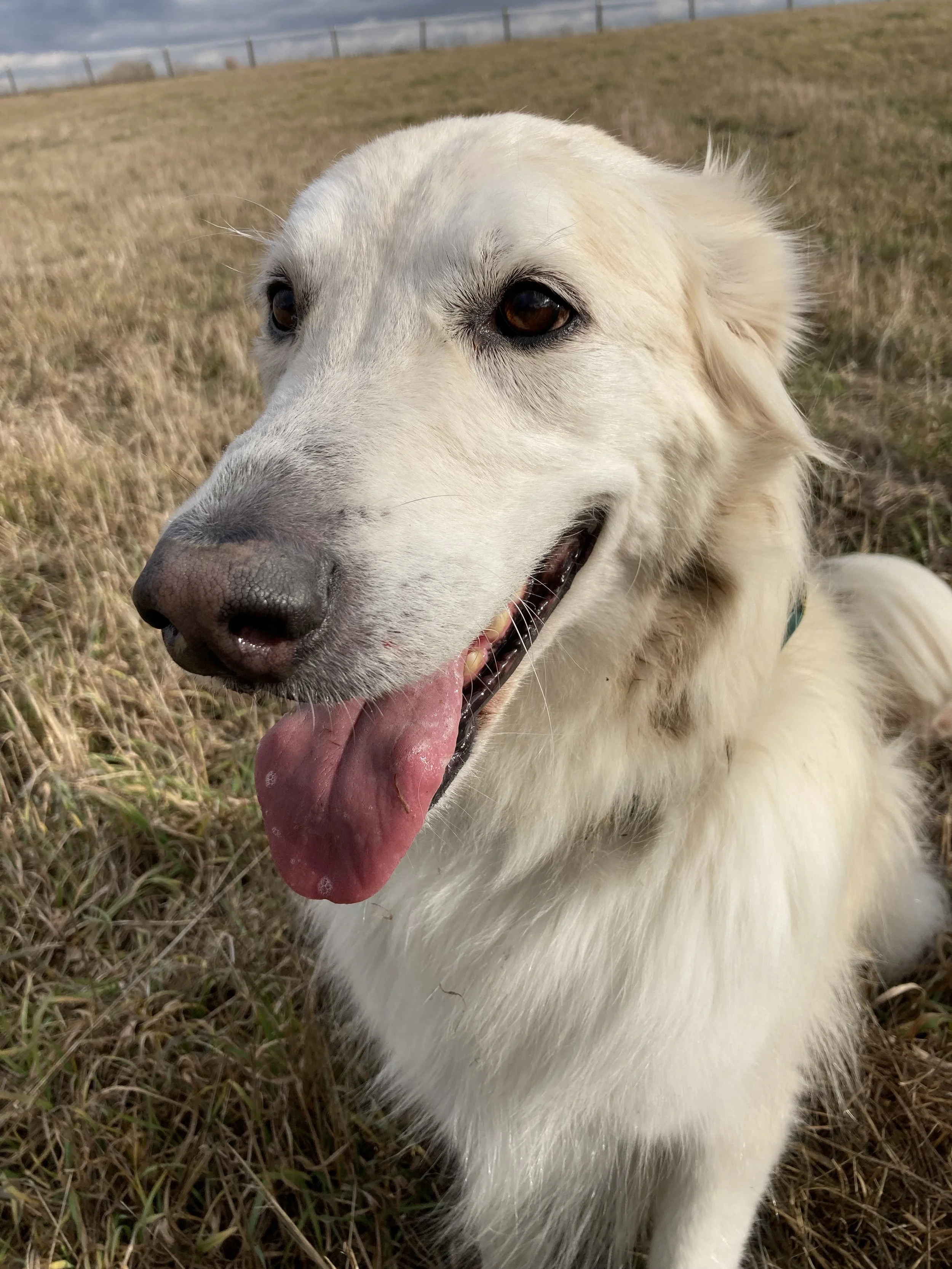
Mission
Mission’s dad, the Dutch Sheppard, lived on the same property for a number of years. He was later adopted out, but could easily be described as a “suspicious” dog. He would have problems with other dogs and sometimes humans.
One of my first interactions with Mission was during a puppy play session. I had my young Italian Hound, Olive, with me, who had perched herself on top of an A-frame. As she came down, Mission quickly approached and grabbed her from behind. Olive let out a scream and we separated the two. He had drawn blood and she now carries a scar from that interaction. Unannounced to me, this was not his first time biting another dog.
As he aged, he was exposed to more things in life. He was on the subway, brought downtown, experienced crowded areas and festivals, but he was always brought back to an environment where he received little attention afterwards. Prior to adoption, a volunteer would bring him to their home on weekends where he began experiencing “normal” life. After a few months of this, the volunteer was unable to continue and Mission’s owner felt he needed more. I began to take his weekend visits.
When he was at my house on these weekends he was desperate for attention. A classic velco dog. He and Olive had been around each other more prior to this, so there was no negative reaction when he started staying the weekends. When I’d bring him back to his home, I’d often leave him in a crate or room and he would lose it. I would hear him screaming and crying, upset that he had to be back at the property. It was honestly heartbreaking. I had started working with him and he was easy to train, just wanting to please you in any way he could. He had some great skill on him even at a young age.
After repeatedly seeing his reaction coming back to property, his owner decided he needed a family environment. Obviously, I adopted him. As I spent more time with him, I’ve noticed more things. He still has amazing skills. He heels like a pro, wants to work, and is willing to play any training game with you. But he has major challenges.
After years of work, he can walk past a dog as long as we are given enough space, but even still his anxiety is palpable.
He is highly anxious, often reacting to the littlest sound while in the house. He could be in a deep sleep, a car will beep, and he’s at the window in seconds. He frequently displays displacement behaviours. Displacement behaviours are normal behaviours expressed out of context. For example, it can be -30 outside and as soon as we leave the house for a walk, he’s panting. For an entire hour walk, he’s panting while his ears are pinned back. He’s uncomfortable in new environments. He can acclimate, but it takes a lot of time. Often when he’s unsure, he’ll jump up at you, putting his paws on your shoulders while he looks at you with whale eyes. He does not like the car, but if that’s his mode of transportation to a new environment, the car then becomes his safe spot. He’ll often pull his way back to car and will jump in prior to the gate being fully open. He’ll smack his head on the door just to get to his safe spot sooner.
He’s reactive to other dogs. He can be in a class with other dogs, but if they come into his personal bubble, he will bite them. On walks, if a dog is coming in our direction, all our training is out the window. After years of work, he can walk past a dog as long as we are given enough space, but even still his anxiety is palpable. He’ll often snap for treats as I work him around other dogs, sometimes drawing blood. Going to pet stores is out of the question for him, the combination of new environment plus other dogs puts him in overdrive.
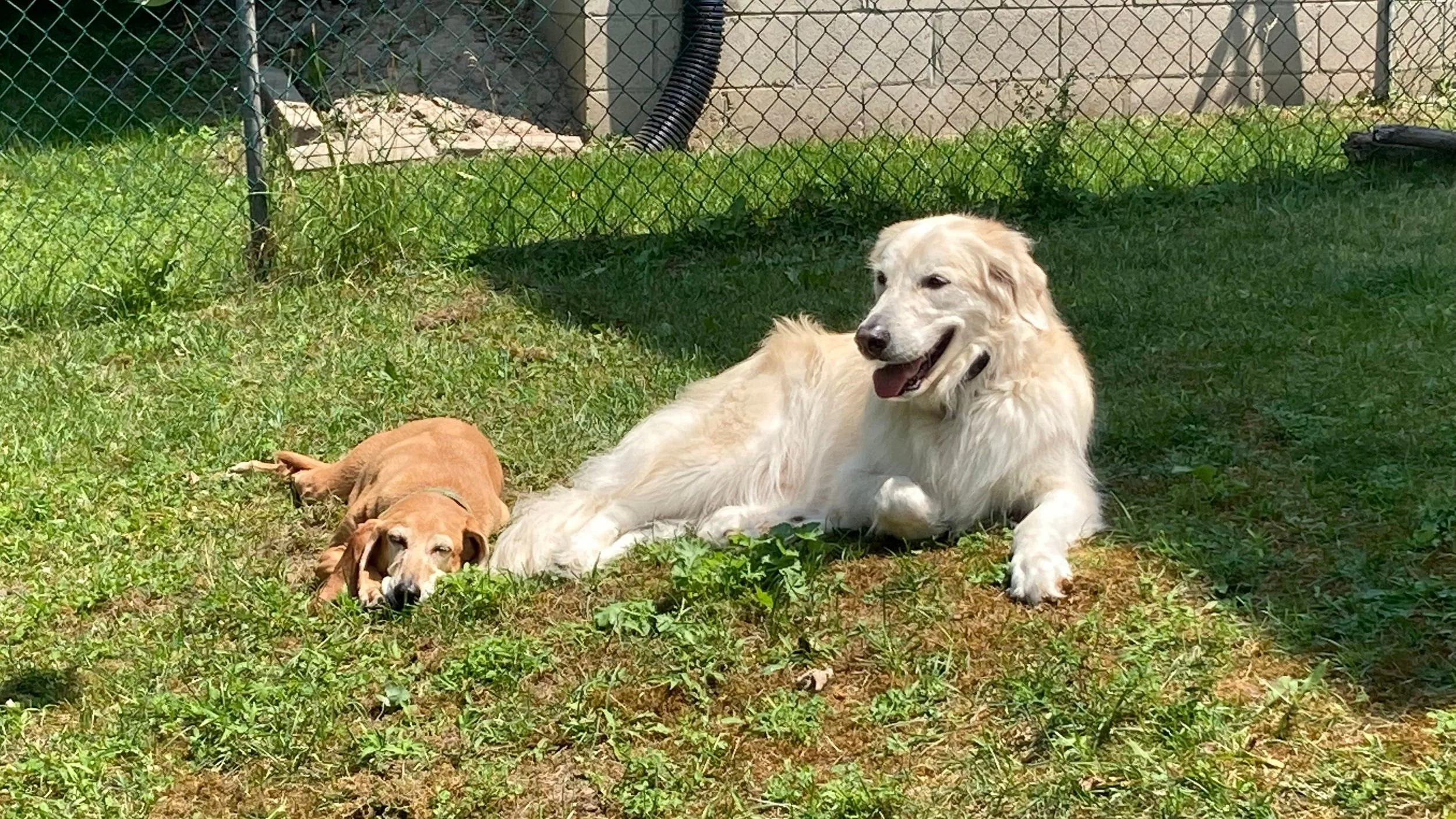
Olive & Mission
I often say the one thing Mission learned from his previous home is how to bark. Even in our own backyard, if he hears a noise, he barks. If it’s a noise from another dog he’s often barking or growling, and eventually has a low whipper while pacing. He does the same thing at the front window if anyone or a dog is being walked by our home. Barking is his go-to response to everything. I can both my dogs in a class, working one at a time, and as soon as I put him away to work with Olive, he’s barking. Non-stop barking.
Life with him is a lot of management.
He has impulse control issues. He reacts first, then asks questions. I’ve given him opportunities to leave situations when he’s uncomfortable, but he still is not at the point yet where he chooses to do so. He can be right beside me in a 3 acre field, hear a dog, and will bolt across the field to charge the fence and bark. For a dog with so much skill, I have been unable to get him to settle. Placement work is a struggle for him. He can do it, but constantly needs to be put back since he has trouble with the separation.
My life with him is a lot of management. I change the environment to help him. I frequently work with him, but find as he’s aged his anxiety has worsened. I have many friends with dogs who ask to visit with their pets, but I know this isn’t a possibility for him. My parents have just recently rescued a new puppy and I know their introduction will be a difficult one. Not only on his part, but on mine. I have little trust in him around other dogs. I’m currently muzzle training him, so that when I do introduce them I at least have some comfort knowing he will not hurt the new puppy. Some days with him are great, some days are a struggle. Sometimes he wakes up and you can just tell his anxiety is higher than normal. I’m at the point where I’m considering putting him on medication to help with his anxiety and improve his quality of life.
Some might ask, why did I adopt him? There were a lot of red flags to say the least, both as a result of his early environment and his genetics. But like many people, I saw what I wanted. A dog that loved to work, who wanted to cuddle after a long day, and a dog that needed help. In the case of Mission it’s hard to say what has more effect, nature or nurture. Yes his early critical period environment was not the best, but he’s been living in a stable home for approximately 6 years. Can 6 years change a fundamental impressionable period? On the one hand, this early environment may have turned on certain genetic traits he was born with. I may never have answers, but this is the dog I live with and we take life on a day by day basis.
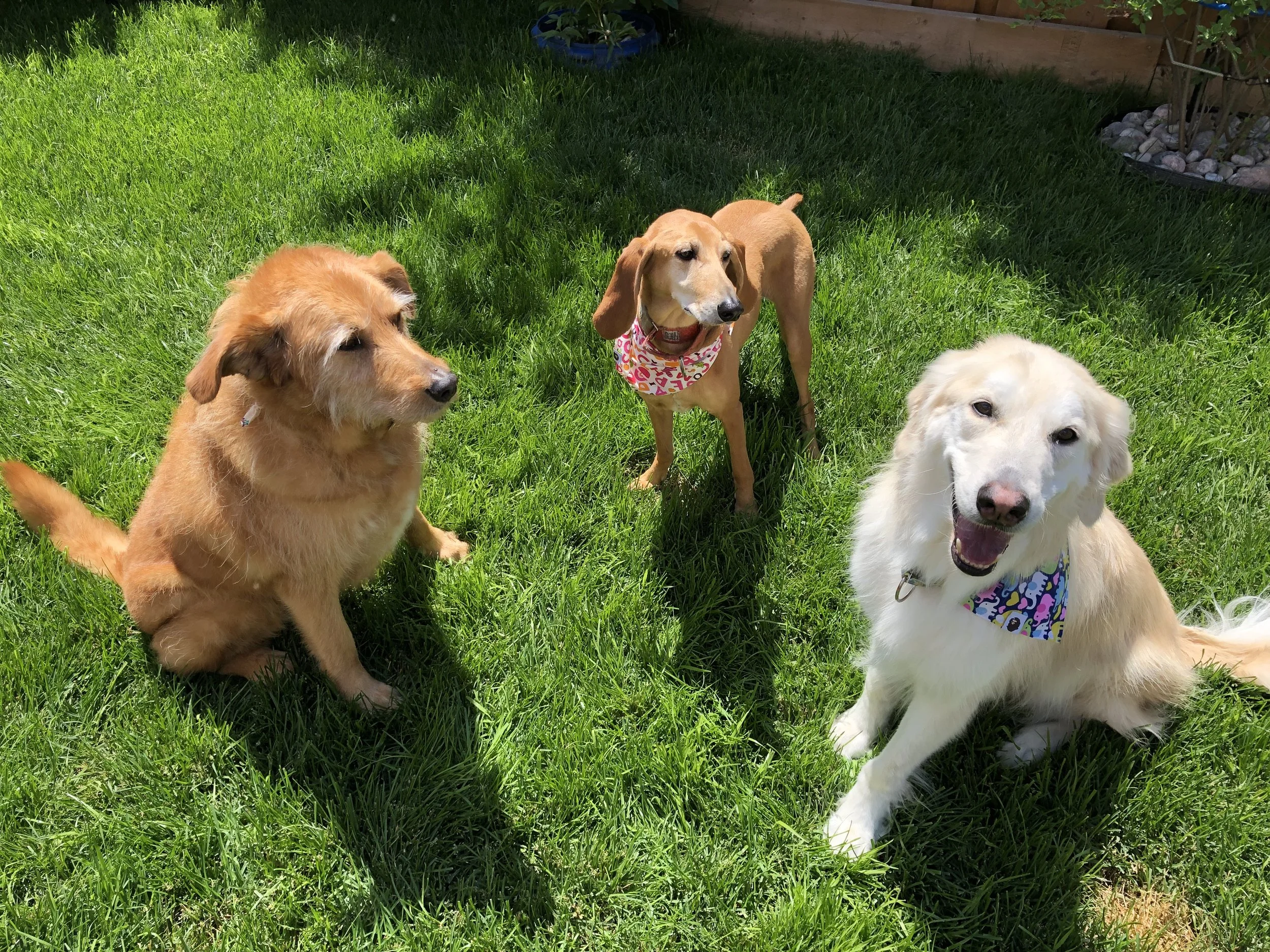
Izzy, Olive & Mission
Bannasch, D., Famula, T., Donner, J. et al. The effect of inbreeding, body size and morphology on health in dog breeds. Canine Genet Epidemiol 8, 12 (2021). https://doi.org/10.1186/s40575-021-00111-4
Miklosi, A. (2016). Dog behaviour, evolution, and cognition. Oxford Univ Press.
